Building a UX Research Community for AI-Powered Health Technology
About the Client
A Health Tech start-up developing an AI-powered wearable that monitors canine health through continuous data tracking, benchmarked by industry gold standards. Their mission is to improve canine health, give owners greater peace of mind, and provide veterinarians with richer clinical data to support better care.
The Challenge
Developing innovative health technology requires more than technical expertise; it requires a deep understanding of the people who will ultimately use it.
The Product team needed regular access to dog owners, veterinary professionals and clinical experts who could provide meaningful feedback throughout the product development journey.
Rather than recruiting participants for individual studies, the goal was to build a trusted research community that could support continuous learning, allowing product decisions to be shaped by real user needs rather than assumptions.
Our Approach: Longitudinal UX Research
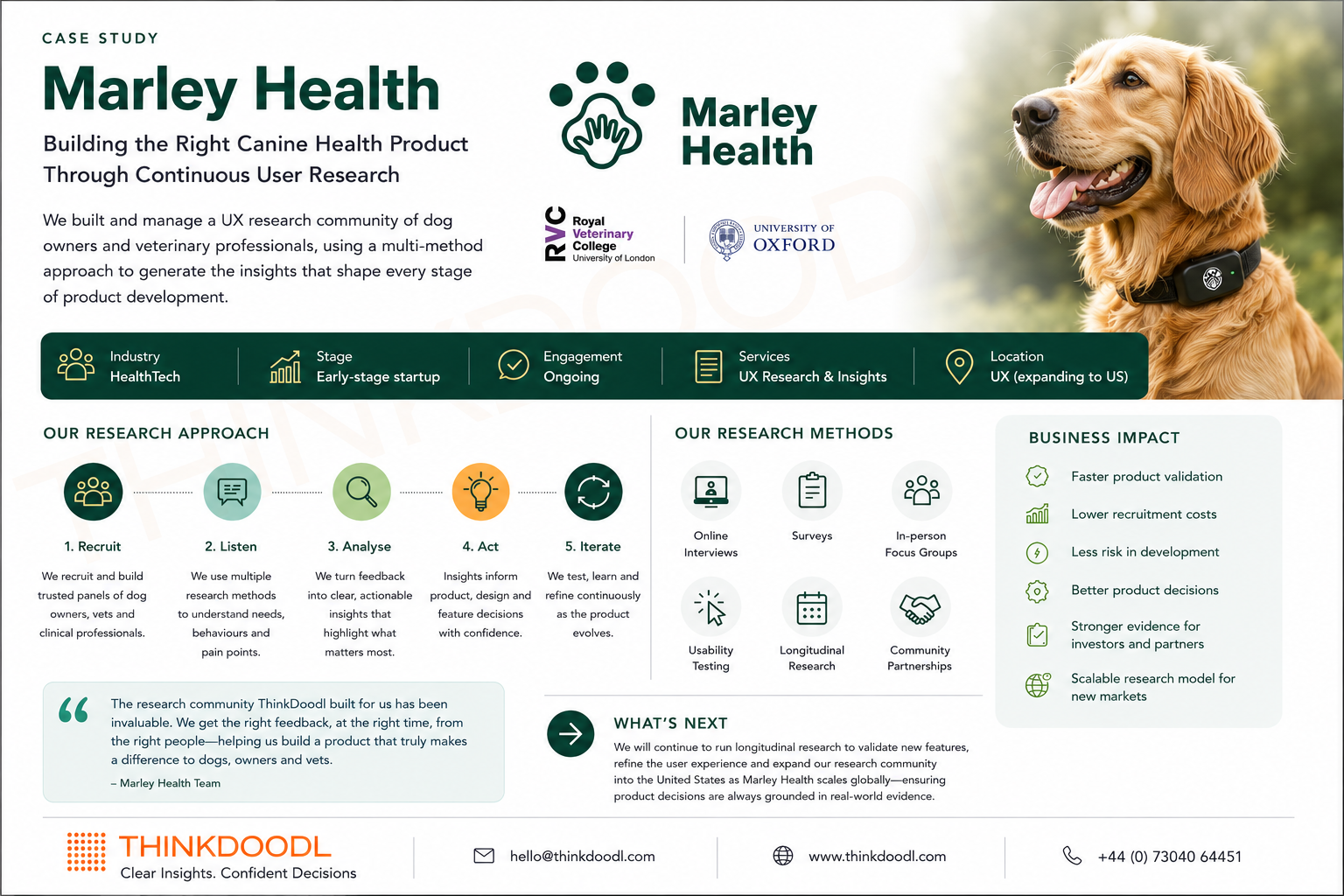
ThinkDoodl designed and implemented a long-term UX research programme that combines multiple research methods to generate richer, more reliable insights throughout product development.
Each research method plays a different role:
Surveys identify patterns and trends across larger groups of users.
One-to-one interviews uncover the motivations, behaviours and unmet needs behind those patterns.
Focus groups encourage discussion, helping validate ideas and reveal new perspectives.
Usability testing shows where people struggle when interacting with the product, allowing issues to be identified before launch.
Longitudinal research follows participants over time, helping the team understand how needs, behaviours and product usage evolve.
By combining these methods, we were able to make product decisions based on evidence from multiple sources, reducing bias and increasing confidence in the direction of the product.
Our Work
Our work includes:
Recruiting dog owners, vets and clinical professionals
Vetting recruited participants
Onboarding recruited panellists to a database
Building and managing dedicated UX research panels
Running online interviews
Designing and distributing surveys
Organising in-person focus groups
Conducting usability testing
Managing participant communications
Synthesising research findings into actionable insights
Advising on UX research strategy and best practice
Maintaining strict Data Compliance
What We’ve Delivered (So Far)
Dedicated UX research panels of dog owners and veterinary professionals
Access to external participants for wider studies
Ongoing participant recruitment and panel management
A longitudinal research programme supporting continuous product development
Moderated interviews
Quantitative surveys
In-person focus groups
Usability testing sessions
Partnerships with veterinary and dog owner communities
Results
The product team, now has direct access to the people who matter most throughout product development.
The research programme has enabled the team to:
Test product concepts with real users before investing further in development
Better understand the needs of dog owners and veterinary professionals
Identify usability issues earlier in the design process
Validate assumptions using multiple research methods
Build relationships with early adopters and advocates for the brand
Create an engaged research community that supports ongoing innovation
Business Impact
Building the right product starts with understanding the right people.
By creating a dedicated UX research community, we have a repeatable way to gather high-quality customer insight throughout the product lifecycle.
Instead of relying on assumptions or isolated research projects, the team can continuously validate ideas, test new features and refine the user experience before significant investment is made in engineering or commercial launch.
Using a combination of surveys, interviews, focus groups and usability testing gives us confidence that product decisions are based on both qualitative and quantitative evidence, not guesswork.
This iterative approach reduces development risk, shortens feedback loops and increases the likelihood of delivering a product that dog owners and veterinary professionals genuinely want to use.
Business Value
Faster product validation throughout development
Better-informed product and design decisions
Reduced risk of building features users don't need
Lower recruitment costs through an established research community
Earlier identification of usability issues
Stronger evidence to support investors and strategic partners
Greater confidence before product launch
A scalable research programme that can expand into new markets
What's Next
As we move towards wider product adoption, user research will remain central to every stage of development. The established research community provides a strong foundation for continuous testing, rapid feedback and ongoing innovation.
The next phase includes expanding the research programme, validating new features with existing users and ensuring every product decision is informed by real-world evidence. This approach helps us build not just a technically advanced product, but one that genuinely improves the lives of dogs, supports veterinary professionals and delivers lasting value to pet owners.
Services Provided by ThinkDoodl
UX Research Strategy
Participant Recruitment
Research Panel Management
Longitudinal Research
User Interviews
Surveys
Focus Groups
Usability Testing
Insight Reporting
UX Research Consulting